Open today: 10:00am - 5:30pm (last entry 4:30pm)

Unearthing Post-Tudor Clay Pipes Found on the Mary Rose

In May and June this year, we joined the Mary Rose Trust team as Collections Development Interns from the University of Southampton. One of the projects we worked on was cataloguing the post-Tudor material recovered from the Mary Rose site. As part of this work, we looked at a huge variety of intricately designed clay smoking pipes.

image description

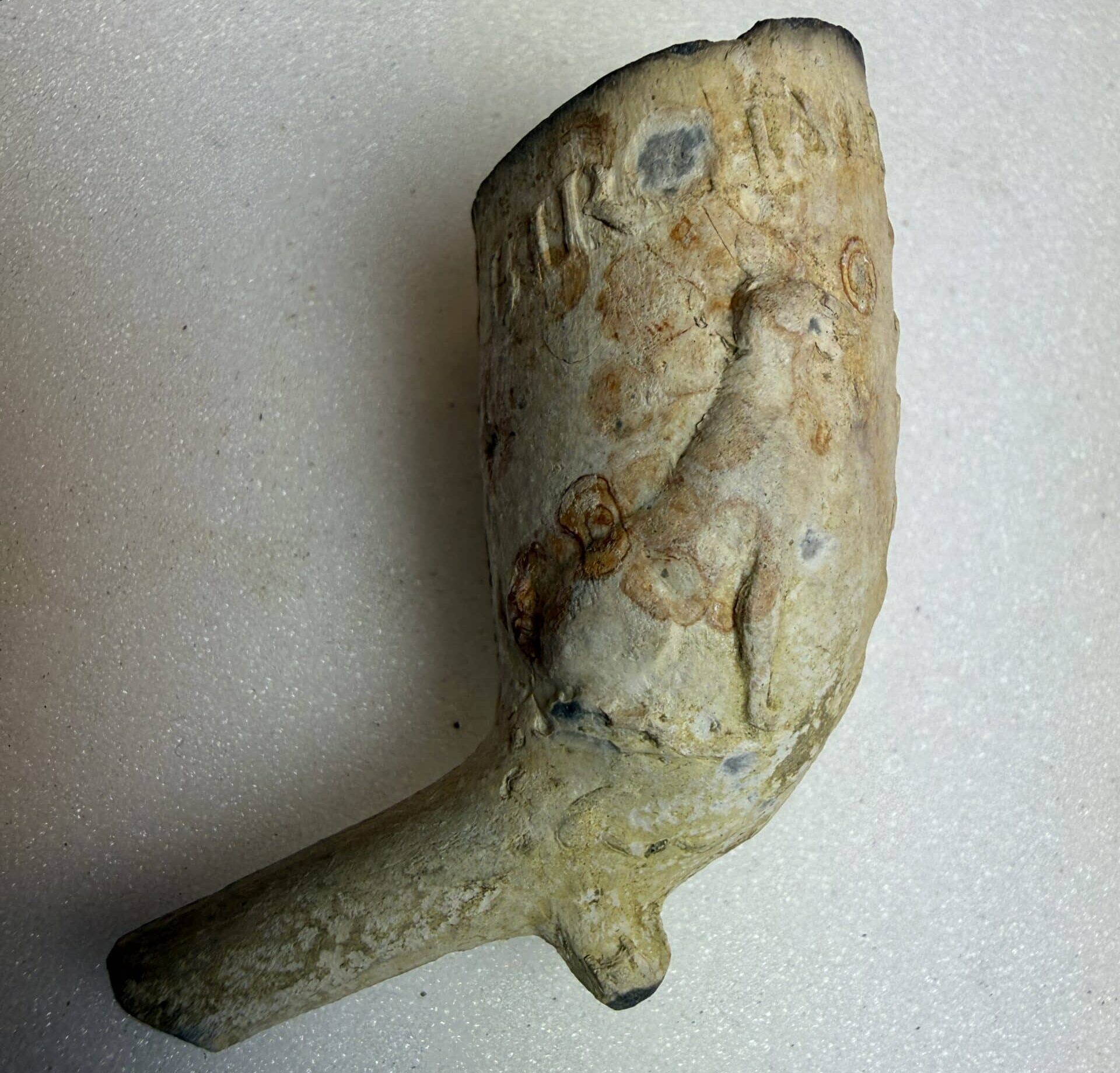
Detail of clay pipe 73A0064 showing a dog

From the 16th Century to the early 19th Century these clay pipes were cheap and disposable ways of smoking tobacco. The layer of silts and sediments that they were recovered from during the excavations reflected the period they were made – so the deeper the excavations went, the older the material tended to be.

Many of the pipes found on the Mary Rose wreck site were produced locally, in Portsmouth, as early as the 1620s. However, others can be traced to various locations across Europe. It is interesting that such a large number of pipes were found during the excavation.  This reflects the amount of cultural trade within Portsmouth as well as highlighting local artisanal talent.

This clay pipe contains just the ‘bowl’ of the pipe, where the tobacco would have been placed. The pipe is decorated with a dog on one side and another animal, in too poor condition to identify, on the other. However, it is believed to be a ferret or something similar. The pipe also appears to have the words “BIRCHALL” and “CHATHAM” inscribed on it. This tells us that the pipe maker had the last name Birchall and that the pipe was made in Chatham, Kent.

image description

Detail of clay pipe 03A0343 showing a unicorn

This Georgian clay pipe, excavated from the Mary Rose site in 1979, features the bowl and part of the stem and is a blue-grey colour. The bowl is decorated with the Royal Coat of Arms, with a crowned lion and unicorn on either side. It is dated to 1714-1801, based on the Royal Coat of Arms being the Hanoverian version from the rule of George I, Elector of Hanover. Below the arms is a scroll which states ‘DIEU ET MON DROIT’ (which means “God and my right” – the motto of the British monarch).

image description

Detail of clay pipe decorations on 78A0217 showing William IV (left) and Princess Caroline (right)

This heavily decorated clay pipe bowl, dated to 1750, depicts William IV, Prince of Orange, and Princess Caroline. It includes inscriptions in both French and Dutch in a scroll crossing its surface, along with additional embellishments, including a Royal Coat of Arms (1714-1801), a crown, a shield, and decorative flora. The imagery and inscriptions suggest Dutch manufacture or influence, which is supported by similar “Oranje Pipes” originating in the Netherlands. These pipes were produced in large numbers for royal commemorations and for occasions celebrating the House of Orange. This unique find is an example among many others that show how the Solent was a hub for international exchange and movement.

image description

Detail of clay pipe 77A0050 showing three ostrich feathers (left) and floral decoration (right)

This clay pipe was manufactured in Fareham (1752-1816) by the pipe maker Arthur Coster. The decoration of the pipe features the Prince of Wales’s Coat of Arms, identified by a trio of ostrich feathers. This popular design was used commemoratively to display loyalty to the Prince. However, they have also been associated with approximately 80 “Prince of Wales”- pubs. In addition to regal imagery, the pipe features floral engravings on its front.

image description

Ribbed design on the clay pipe 79A1122

Similarly, produced by Arthur Coster (1752-1816), this clay pipe features a typical ribbed decoration with his initials A.C. clearly visible on the bottom point (spur). The outside was also a beautiful blue-grey colour. Given its shape and size, along with its manufacturer, it was likely produced between 1770 and 1816, providing a rare example, during a period of overall production decline.

It has been very interesting to see the variety of shapes and designs within the collection. As clay pipes were only produced after the sinking of the Mary Rose, it raises many questions about how these everyday objects came to be associated with the wreck site of one of the UK’s most well-known shipwrecks. They offer an interesting insight into the social history of Portsmouth Harbour.

image description

The story of the Mary Rose

Discover the full 34-year long story of the Mary Rose

Find out more
image description

Why did the Mary Rose sink?

Was the sinking of the Mary Rose similar to that of Vasa

Find out more
image description

The Grace Dieu of Henry V

Another shipwreck, this time from England, and a lot earlier…

Find out more
image description

The Battle of St Mathieu

10th August was also the date of the Mary Rose‘s first battle, in 1513.

Find out more
image description

The Vasa Museum

Discover more about the story of this spectacular Swedish vessel

Find out more
The Tale of Two Ships : Vasa – lost on her maiden voyage

The Tale of Two Ships : Vasa – lost on her maiden voyage

In 1961, the people of Sweden brought their own historic ship to the surface, with an origin story that has, on occasion, been mistakenly attributed to someone else…

Read More
The (Fiddle) Loom of Time

The (Fiddle) Loom of Time

Read More
Choosing a conservation treatment for a unique artefact

Choosing a conservation treatment for a unique artefact

Read More