In June 1981, diver David Burden spotted the slatted edge of a curious implement poking through the silt in the murky Solent seabed. It was a rectangular piece of wood about a meter long, found nestled against loose string, woven fragments, and rigging tools in a cabin on the main deck of the Mary Rose.
Figure 1 Dive log by David Ian Burden, 12 June 1981
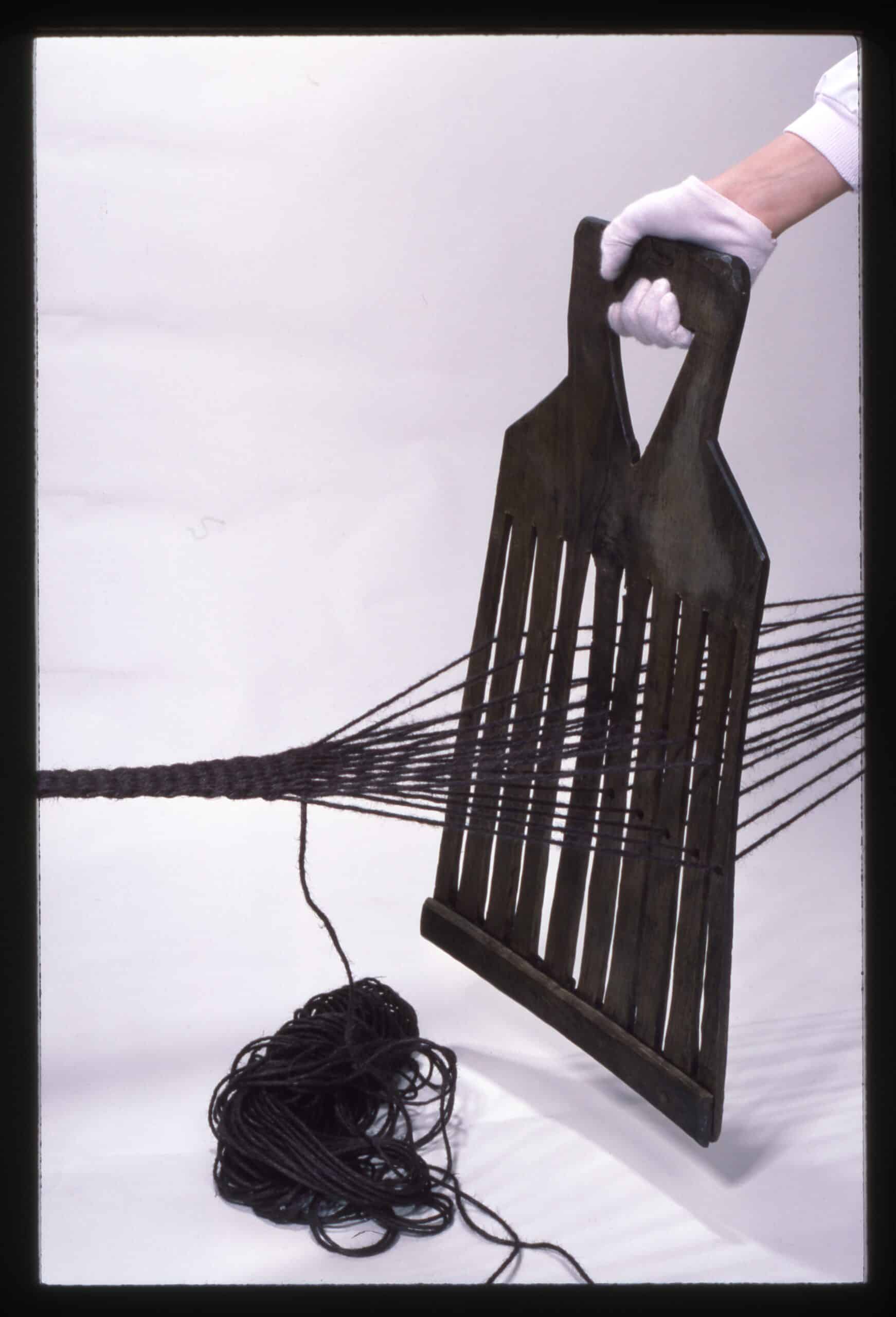
Fellow diver Barrie Burden (wife of David Burden) lifted the object to the surface soon after. What they had found was a gigantic version of a rigid heddle. The earliest surviving rigid heddles date to Roman-era Britain, almost two thousand years ago, and they were usually used to weave narrow bands, tapes, or ribbons. In Tudor times, small heddles about the size of a palm were used by women to weave ribbons for fastening or decorating garments. The heddle excavated from the Mary Rose, on the other hand, measures 65.5cm in height and 37.5cm in width—much, much larger than a palm!
It was named the “fiddle loom” as a catchier alternative to the term “sword-matting tool” used by the Navy, due to a combination of factors: its resemblance to the fiddles found on the Mary Rose, its similarities to fiddle blocks, a kind of rigging pulley used on ships, and old mis-spellings of heddle that swapped the letters h or he with f or fe.
Figure 2 Mary Rose fiddle loom after conservation
Notwithstanding its size, the fiddle loom functioned the same as any other heddle: long warp yarns were threaded through its 10 holes and 9 slats, pulled taut and secured at either end, then the weaver could insert horizontal weft yarns through the “shed” opening that resulted from moving the loom up and down on the warp. As no other confirmed weaving implements were discovered together with the loom, we cannot be certain what kinds of bobbin, shuttle, or beater were used with the loom—or at all.
Figure 3 Weaving experiments on the actual Tudor fiddle loom, hand belonging to Sue Bickerton (Conservator)
But that doesn’t mean we can’t try to find out how the loom was used! Starting in 1982, after the Mary Rose was raised and many objects had gone through conservation treatment, experiments on how to weave with the loom started. Diver and archaeologist Barrie Burden led a series of trials, working with conservators to thread the actual excavated fiddle loom with jute string and carefully attempt to weave on it ( Figure 3 ).
Figure 4 Reproduction strops (MRE 26) shown next to excavated strops (MR81A4083)
One person raised and lowered the fiddle loom, holding onto the handle at the top, while another passed a ball of weft thread back and forth through the warp threads and beat it in with a ruler. The resulting strop they produced was remarkably similar in width and structure to the woven strop fragments excavated near the fiddle loom ( Figure 4 , top is reproduction strop, bottom is excavated Tudor strop). The strops found near the fiddle loom all had less than 19 warps, the maximum possible on this particular loom, so it is possible that they were indeed woven on board the Mary Rose.
The original strops on the ship were theorized to have been used to move or hang up the many casks and chests found on the Mary Rose. In 1988, another experiment was undertaken, this time to weave strops for a display in the old Mary Rose museum in Boathouse 5. With two people weaving on a replica fiddle loom, it only took half an hour to weave three-meter-long strops, which then wrapped around a chest (supported with acrylic at the bottom, of course) to suspend it in the air for display ( Figure 5 ). It hung like this for many years in Boathouse 5.
Strops may have served another purpose: to reinforce the ropes and rigging of the ship.
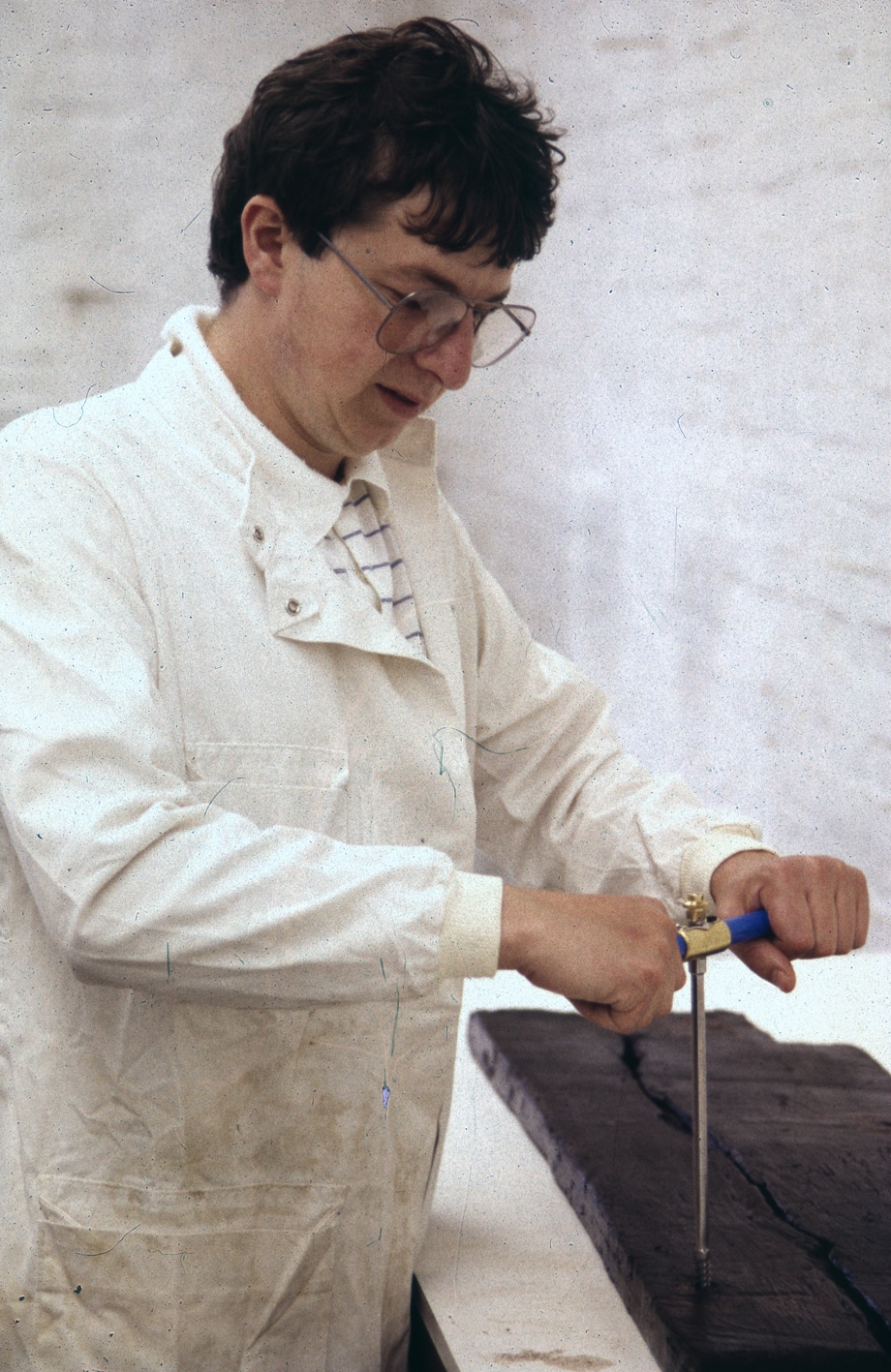
Figure 5 Simon Ware (Collections Assistant) and Carol Lacey (Display Technician) installing strops in the old Mary Rose museum
When the fiddle loom was first identified by Barrie Burden and Finds Assistant Maggie Richards in the early 1980s, it was called a “sword matting tool”, as they found mentions of matting woven on ships in 19th century seafaring manuals, mostly used to prevent ropes from chafing. The “sword” refers to a beater, a wooden knife used to push the horizontal weft threads tightly together while weaving. In Herman Melville’s Moby Dick (published 1851), the protagonist Ishmael spends some contemplative time weaving a sword-mat intended as additional lashing for their boat. Ishmael uses his hand as the shuttle to pull weft threads through the warp, while his friend Queequeg beats the wefts in with an oaken sword. The monotony of this task drives Ishmael to philosophizing; the warp becomes Necessity, his shuttle the hand of Free Will, and Queequeg’s sword Chance, weaving together his destiny on the Loom of Time.
While the sword matting in Moby Dick required two people to weave, I wanted to test if one could operate the fiddle loom on their own. For a demonstration in the museum over Easter this year (2026), I tried out another way of weaving with the full-size replica fiddle loom: with the handle facing down. The weight of the handle kept the fiddle loom in place on the warp, which I tensioned in the backstrap manner, by tying the end of the warp to a pillar and the other end to my waist with a belt and a band lock I made from a couple of pieces of wood and two mug hooks. The band lock clamped around the woven end of the strop, and I could loosen it periodically to pull the finished edge further through, to keep the loom within arm’s reach. I tried going without a shuttle, simply tying the weft up into a butterfly and pushing it through the shed.
I did, however, use a modern beater, a flat rectangular piece of wood, to pack my weft yarns tightly. The resulting strops were similar to the 1980s replica strops, although it took around two hours to weave a 3-meter-long strop on my own, compared to half an hour with two people.
We may never know for sure exactly how the Mary Rose fiddle loom was used. But the weaving experiments show that it would definitely be possible for the sailors on board to weave strops of up to several meters long in a relatively short amount of time, whether it was to hang things up, protect and reinforce ropes and rigging, or perhaps, simply to while away the long hours at sea.
Figure 6 Laurence Wen-Yu Li (PhD Placement Researcher) weaving with the fiddle loom, April 2026.
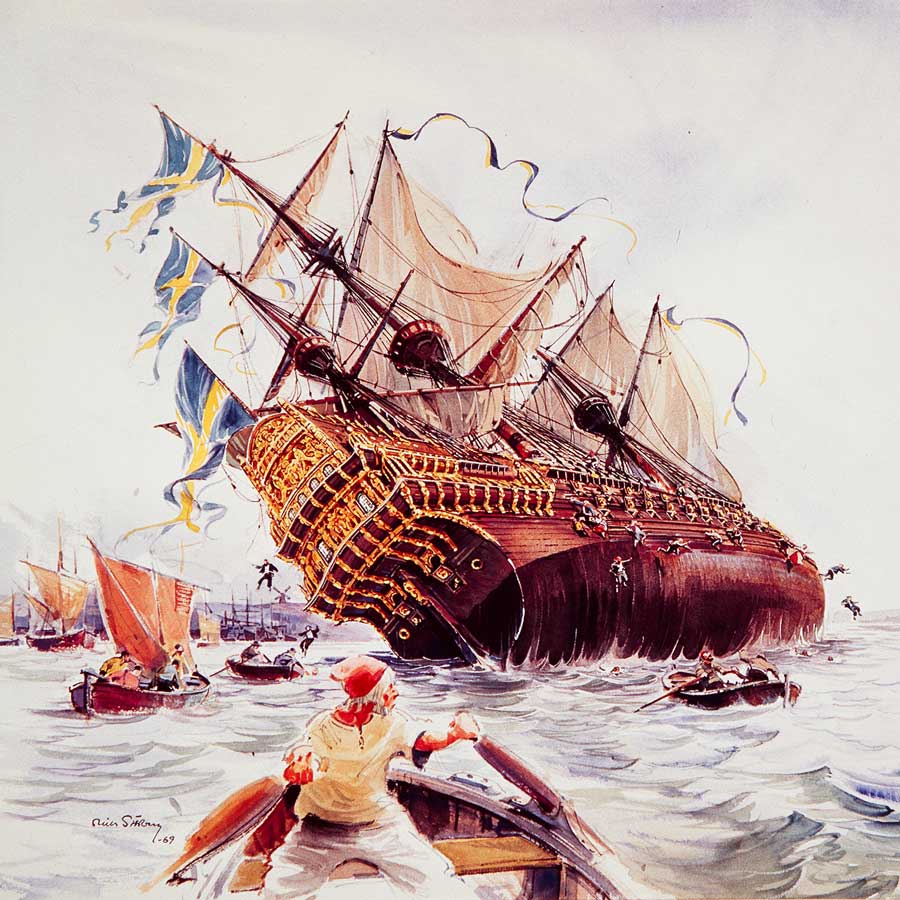
The Tale of Two Ships : Vasa – lost on her maiden voyage
In 1961, the people of Sweden brought their own historic ship to the surface, with an origin story that has, on occasion, been mistakenly attributed to someone else…